
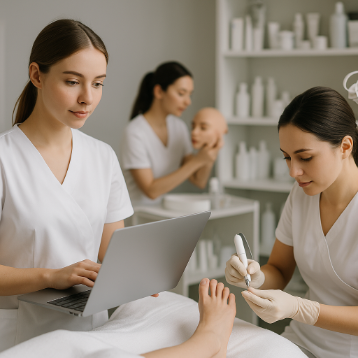
Technology has changed professional education across skilled trades, but in beauty and foot care the shift is especially significant. Kosmetik und Fußpflege depends on precision, hygiene, observation, and confident client interaction, all of which can be taught more effectively when digital tools support the learning process. The most valuable change is not that screens replace practice, but that technology can prepare students better, deepen understanding faster, and make in-person training more meaningful.
Why technology matters in Kosmetik und Fußpflege education
Training in cosmetics and foot care has always required a careful balance of theory and practice. Students need a solid understanding of skin structure, nail conditions, sanitation protocols, treatment sequences, and client wellbeing before they can perform services with confidence. In the past, much of this knowledge was delivered through textbooks, demonstrations, and repeated observation. Those methods still matter, but technology has expanded the range and quality of learning materials available.
High-resolution visuals, guided video demonstrations, anatomy apps, digital quizzes, and structured learning platforms allow learners to revisit complex techniques at their own pace. That matters because many practical skills in Kosmetik und Fußpflege rely on details that are easy to miss in a live classroom. The angle of a tool, the pressure of a movement, the order of hygienic steps, and the visual signs of a skin or nail issue all become clearer when students can pause, review, and compare examples.
Technology also supports consistency. Instructors can standardize demonstrations, assessment criteria, and safety procedures across different groups of students. For a field where hygiene and method are central, this consistency is not a minor advantage; it helps build professional habits early.
Digital tools that improve practical learning
The strongest use of technology in education is not passive consumption but active reinforcement. In well-structured programs, digital tools help students prepare before practice, reflect after practice, and identify where they need improvement. Students exploring pathways in Kosmetik und Fußpflege often benefit most from courses that combine face-to-face instruction with clear digital learning support rather than treating theory and practical work as separate worlds.
Several tools have become particularly useful in this context:
- Video-based technique demonstrations: These help students study treatment flow, body positioning, and instrument handling before entering the practical room.
- Digital image libraries: Curated photos of skin, nails, and common conditions improve visual recognition and clinical observation.
- Interactive hygiene modules: Step-by-step sanitation training helps learners internalize procedures that must become automatic in professional practice.
- Online assessments: Short tests and scenario-based tasks reveal gaps in understanding before students work on real models or clients.
- Progress tracking tools: Digital portfolios allow students and instructors to monitor development in technique, speed, precision, and client care.
These tools are especially valuable because they support repetition without wasting practical time. A student can review the theory of contraindications, instrument care, or treatment sequencing at home, then use classroom hours for supervised correction and hands-on refinement. That shift improves the quality of contact time with instructors.
Traditional learning and technology-enhanced learning
| Area of Training | Traditional Approach | Technology-Enhanced Approach |
|---|---|---|
| Technique demonstration | One live demonstration, limited replay | Recorded demonstrations available for repeated review |
| Visual diagnosis practice | Textbook images and occasional examples | Extensive digital image sets and guided comparisons |
| Hygiene training | Lecture and checklist-based instruction | Interactive modules with sequencing and recall exercises |
| Feedback | Verbal comments during class | Verbal feedback supported by digital notes or progress logs |
| Independent study | Reading and note-taking | Structured review through video, quizzes, and guided tasks |
The limits of technology and why hands-on practice still matters
For all its value, technology cannot replace the physical realities of professional training. Beauty and foot care are tactile disciplines. Students must learn pressure control, ergonomic positioning, instrument handling, cleanliness under time pressure, and the subtle coordination needed to work safely on another person. No video can fully simulate the feel of the skin, the resistance of the nail, or the challenge of maintaining calm precision while communicating with a client.
This is why the best educational model is blended rather than fully digital. Technology should handle preparation, reinforcement, observation, and documentation. The classroom and treatment space should remain the place where students translate knowledge into action. Practical training also teaches adaptability. Real clients do not present textbook conditions in textbook order. They have preferences, sensitivities, anxieties, posture differences, and individual expectations. Students need supervised experience to develop judgment, not just memory.
There is also an ethical dimension. In Kosmetik und Fußpflege education, students must understand the boundary between cosmetic care and conditions that require referral. Technology can teach warning signs, but responsible decision-making grows through guided discussion, case review, and instructor-led correction.
How technology supports hygiene, professionalism, and client communication
One of the most important benefits of modern learning tools is their ability to strengthen professional standards beyond pure technique. Hygiene is not simply a chapter to memorize; it is a repeatable system that protects both practitioner and client. Digital checklists, process videos, and timed procedural exercises help transform hygiene from theory into routine.
Technology also improves communication training. Students can review consultation frameworks, practice treatment explanations, and learn how to document client information clearly and accurately. This matters because a successful treatment is shaped not only by technical execution but also by trust, clarity, and informed consent. A student who understands how to explain a procedure, ask the right questions, and recognize when not to proceed is already developing professional maturity.
Useful educational programs often build this progression through a simple sequence:
- Learn the principle through reading, guided media, and instructor explanation.
- Observe the method in a demonstration with attention to order, hygiene, and technique.
- Practice under supervision with immediate correction.
- Reflect on performance using notes, assessments, or progress records.
- Repeat with greater independence until consistency is achieved.
When technology supports this process, it gives students structure between lessons and helps instructors focus on the areas where human supervision matters most.
What strong Kosmetik und Fußpflege education should look like now
As technology becomes more integrated into training, quality should be judged by how thoughtfully it is used, not by how much of it appears. A strong program does not overwhelm students with tools. Instead, it selects methods that genuinely improve understanding, safety, and readiness for practice.
Good education in this field should include:
- Clear integration of theory and practical work, so digital learning supports treatment performance rather than sitting apart from it.
- Serious hygiene instruction, reinforced repeatedly through both teaching materials and practical expectations.
- Visual learning resources, especially for anatomy, skin and nail observation, and treatment planning.
- Frequent instructor feedback, because correction is essential in developing safe and precise technique.
- Professional communication training, including consultation, documentation, and referral awareness.
- Enough supervised practical hours, because confidence only becomes credible when it is tested in real treatment situations.
Technology is most powerful when it strengthens rigor rather than offering convenience for its own sake. In a discipline built on care, precision, and responsibility, the goal is not faster learning alone. The goal is better learning: more observant, more hygienic, more consistent, and more professional.
Ultimately, the role of technology in Kosmetik und Fußpflege education is to make training sharper, more accessible, and more responsive to the realities of modern practice. It can help students see more clearly, revise more effectively, and arrive at practical sessions better prepared. But the heart of the profession remains human skill: trained hands, disciplined habits, sound judgment, and respectful client care. The future of education in this field belongs to programs that use technology wisely while never forgetting that real mastery is built through guided practice, responsibility, and experience.
To learn more, visit us on:
Beauty Academy | Kosmetikausbildung Österreich
https://www.beauty-ausbildung.at/
0680-3328198
8430 Leibnitz, Augasse 17
Unlock your potential in the world of beauty with Beauty Academy | Kosmetikausbildung Österreich. Dive into professional training programs that are both state-recognized and hands-on, offering courses in cosmetology, foot care, makeup artistry, and nail design. With flexible course models tailored to fit your lifestyle, our academy is your gateway to mastering the art of beauty. Transform your passion into a profession and join a community of aspiring beauty experts today!


